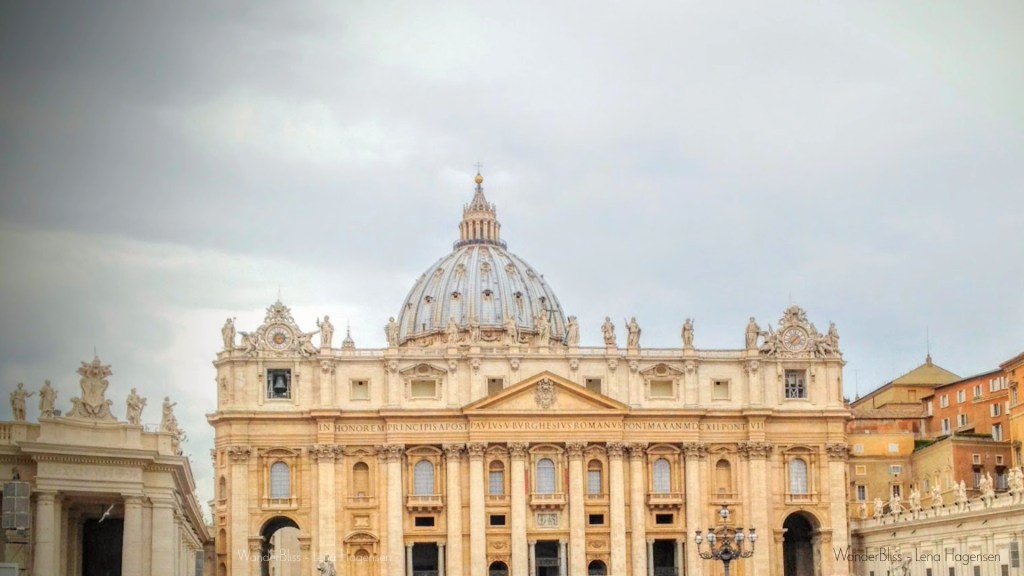
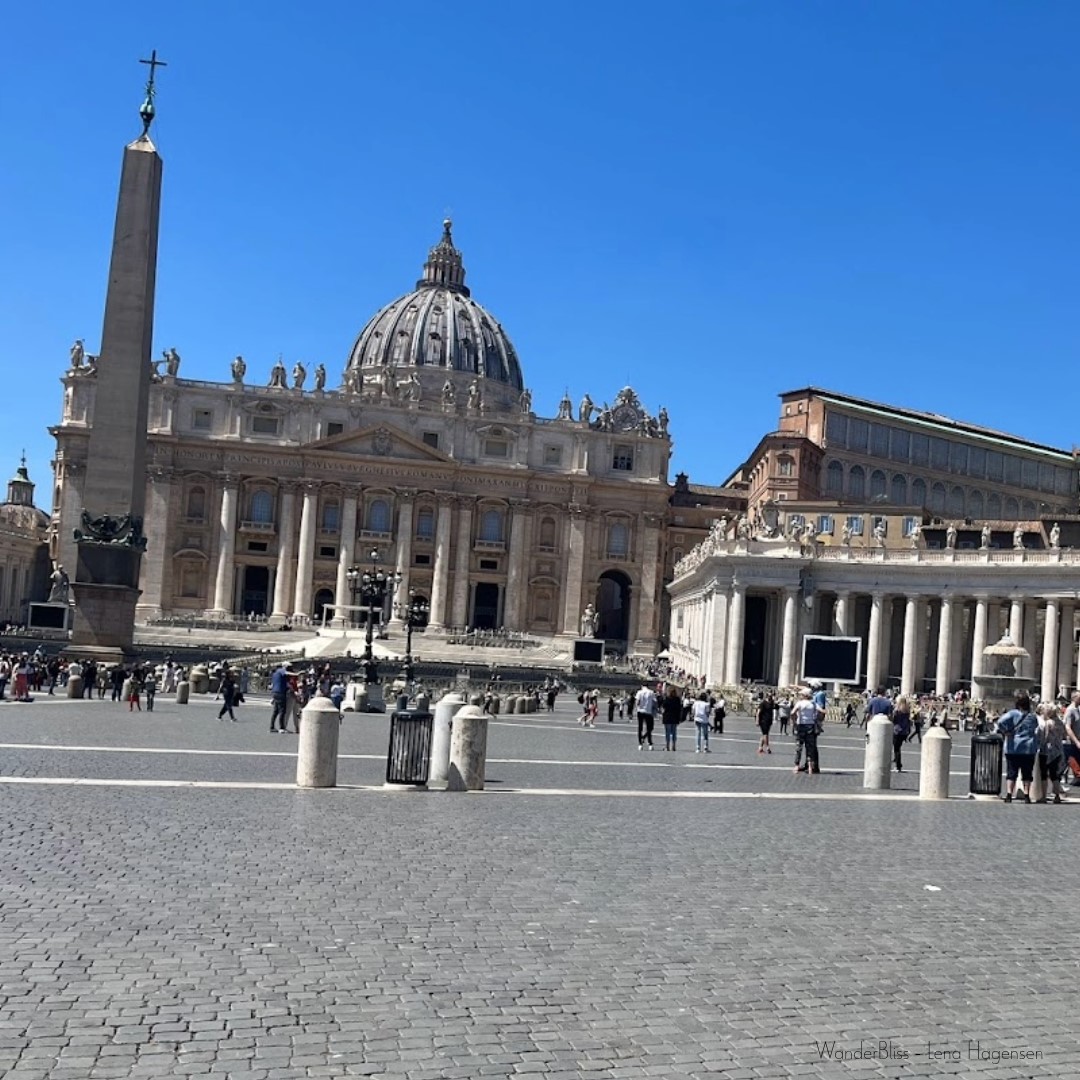
Rome is a city where history and faith dance together in every street, and nowhere is that more evident than standing in St. Peter’s Square – before the magnificent St. Peter’s Basilica.
Religious buildings often hold a special place in the hearts of those who seek to worship God, and this is undoubtedly one of the reasons why St. Peter’s Basilica is among the most visited churches in the world.
Personally, I have visited here six times — not because I have a particular urge to worship, but because I have a deep fascination with the history of religion.
St.Peter`s basilica is a place where art, power, mystery, and devotion meet in overwhelming beauty.
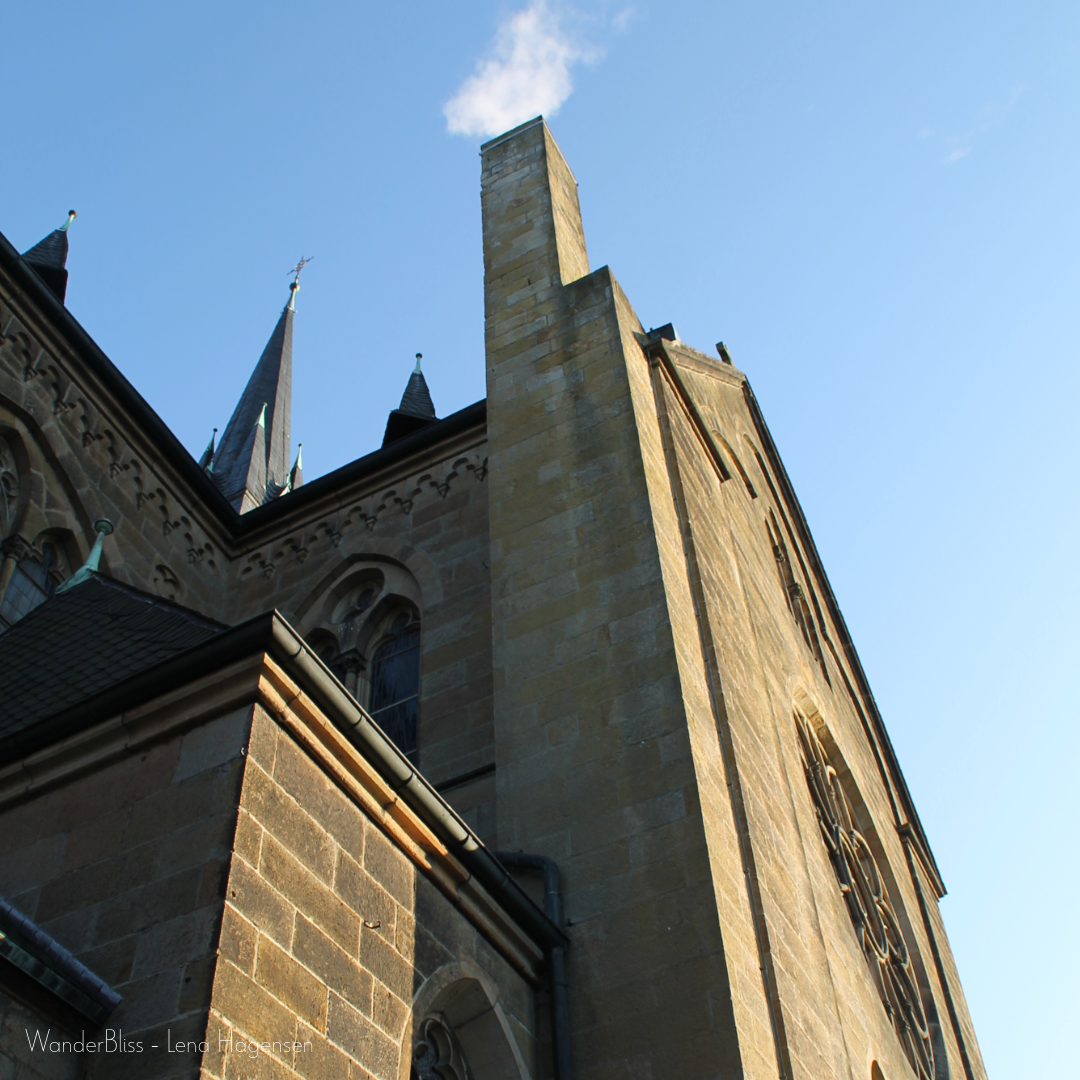

The Basilicas history
«And I tell you: You are Peter, and on this rock I will build my church, and the gates of Hades shall not prevail against it.»
These words are written in the Bible, in the Gospel of Matthew, chapter 16, verse 18, and also inscribed in the dome of one of the world’s largest churches — St. Peter’s Basilica, Basilica di San Pietro.
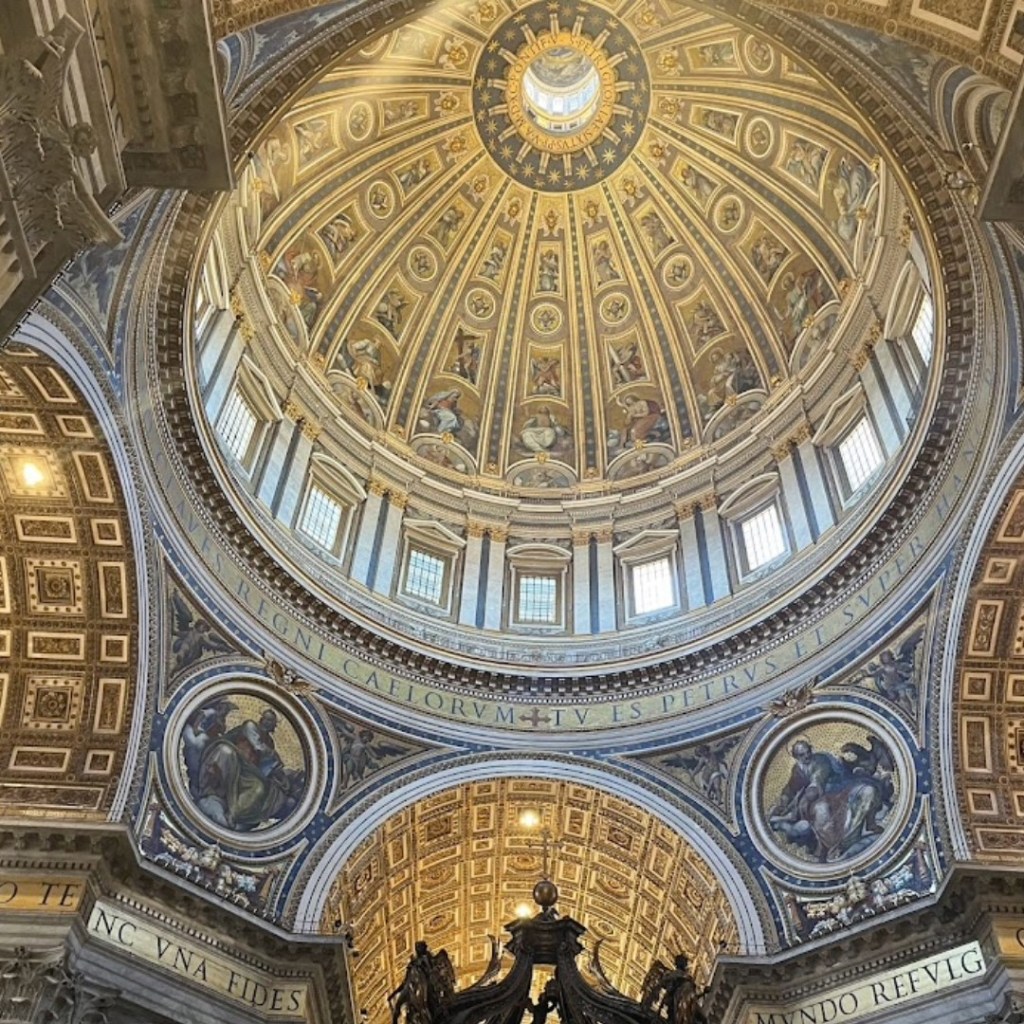
The present Basilica was begun in 1506 and completed in 1626.
Some of the greatest Renaissance artists – including Michelangelo, Bramante, and Bernini – left their marks on its design.
Especially Michelangelo’s enormous dome is a landmark visible throughout Rome.
Before the current structure, the first St. Peter’s Basilica was built on the site where Caligula’s and Nero’s Circus once stood in ancient times.
It is believed that it was here the apostle Peter was crucified, around the year 64 or 67 AD.
Parts of the original basilica, which was erected as a memorial to Peter, are said to still remain in the crypt beneath the present church, alongside what is traditionally regarded as the tomb of St. Peter.
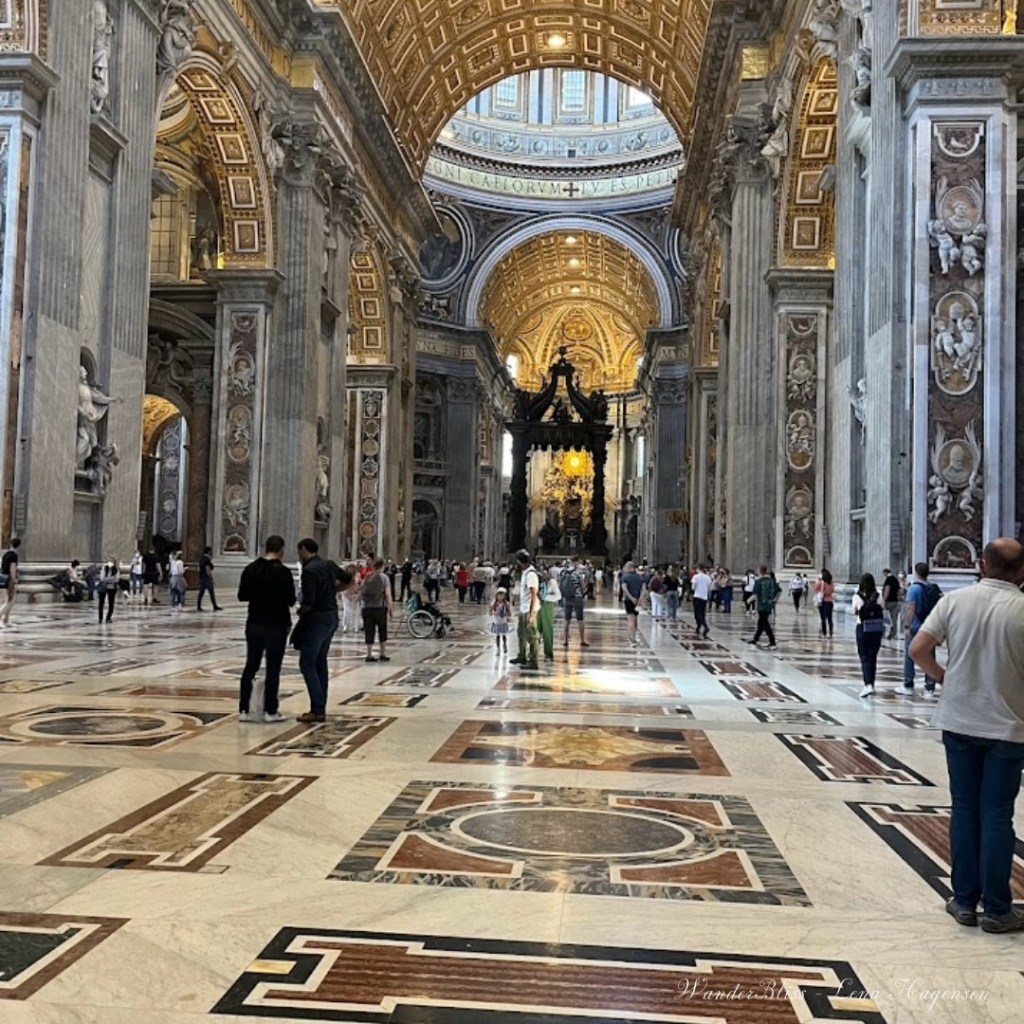
Entering the Basilica feels like stepping into another world:
Gold, marble, towering columns, and detailed mosaics tell a story of faith and human ambition reaching for the divine.
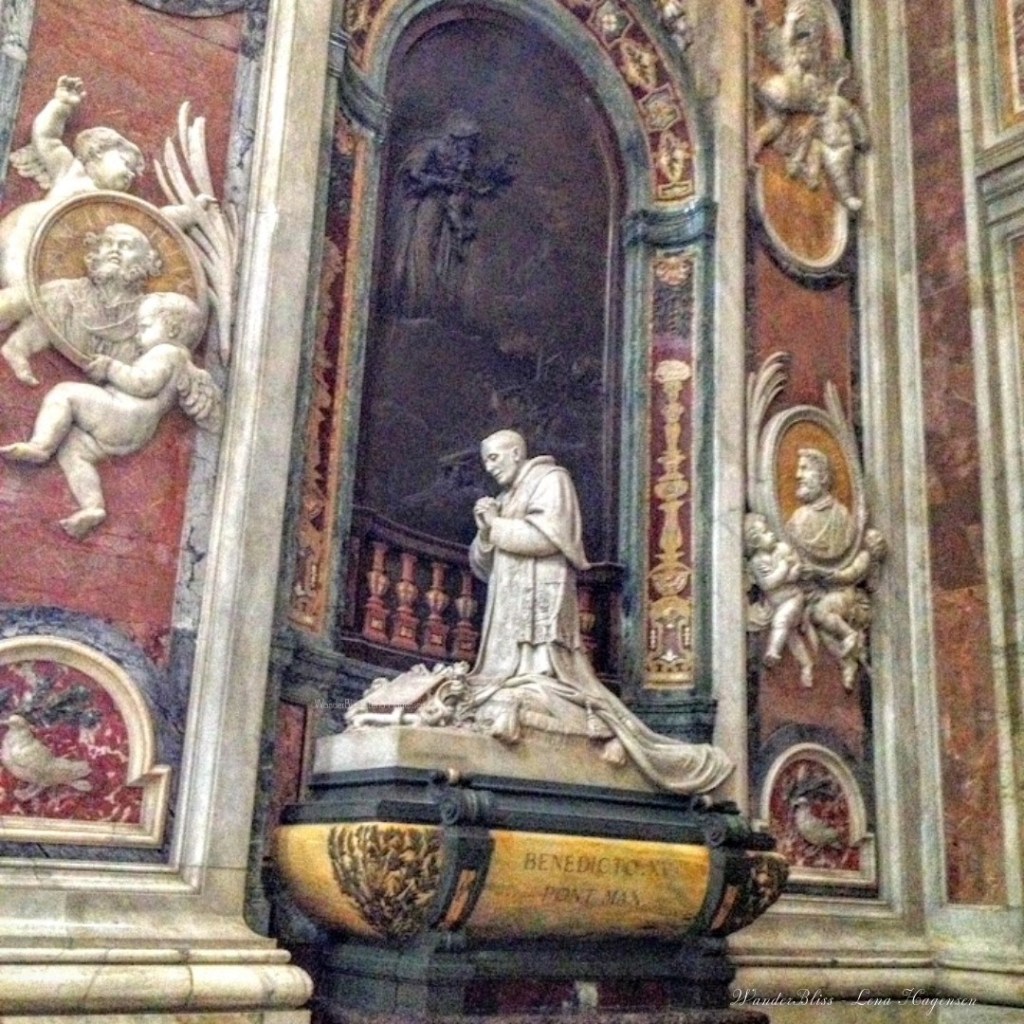
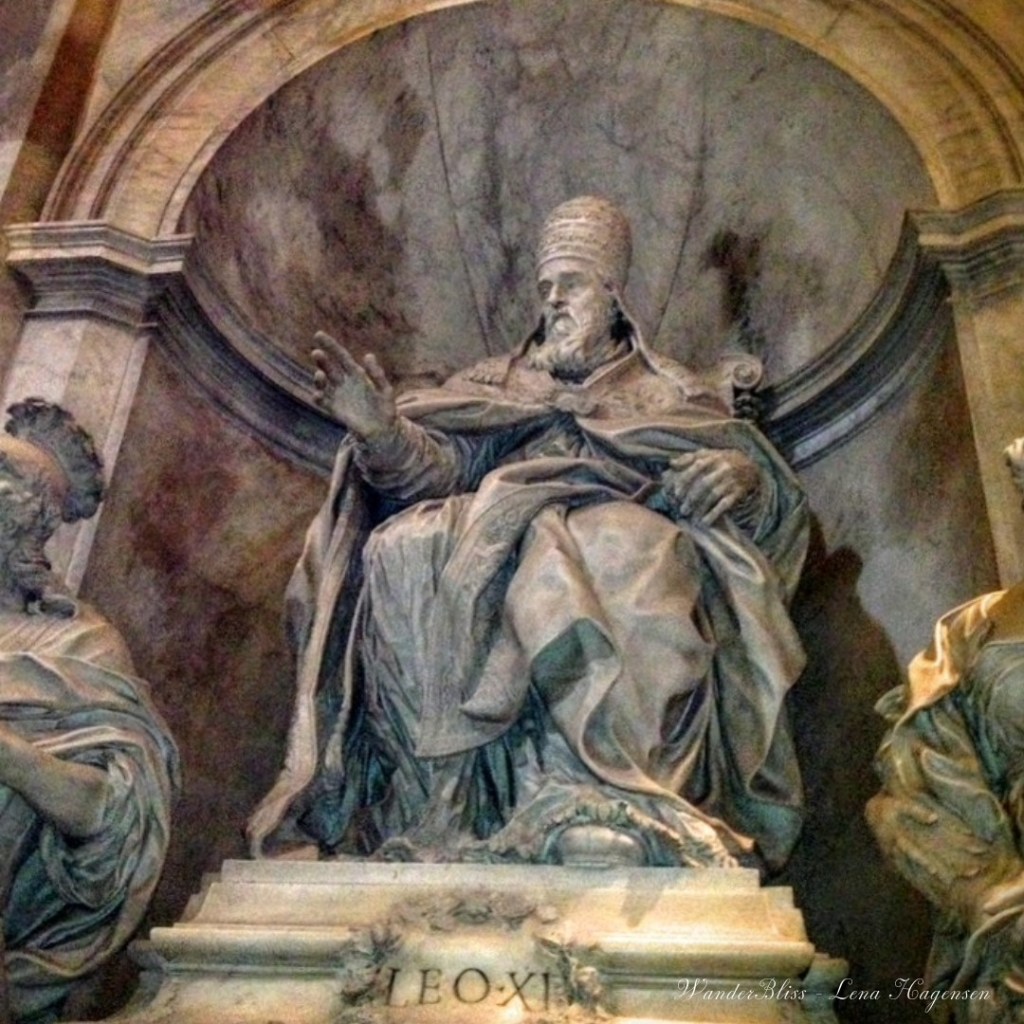
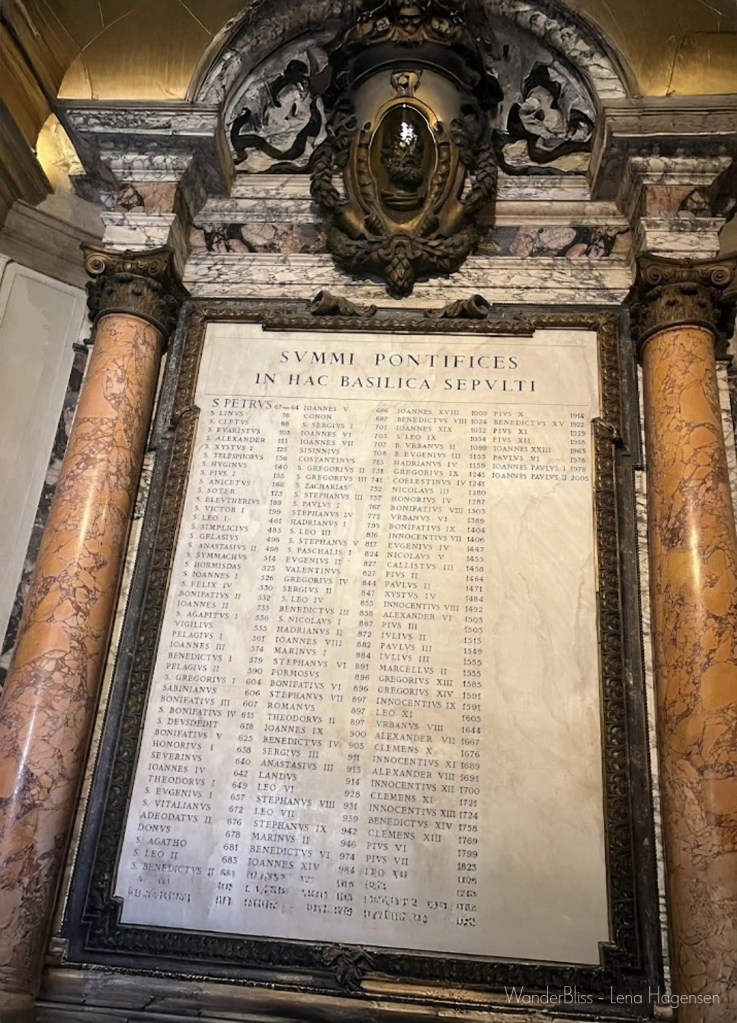
Inside St. Peter’s Basilica, you will find the Papal Plaque — a solemn and powerful reminder of the Church’s long and continuous history.
The plaque lists the names of every pope, beginning with the apostle Peter and extending to the present day, forming an unbroken chain of leadership spanning nearly two thousand years.
Standing before it, one cannot help but feel the immense weight of tradition, faith, and the countless generations that have looked to these spiritual leaders for guidance and hope.
It is a silent witness to the resilience of the Church through centuries of triumphs, trials, and transformations.
Porta Santa (The Holy Door)
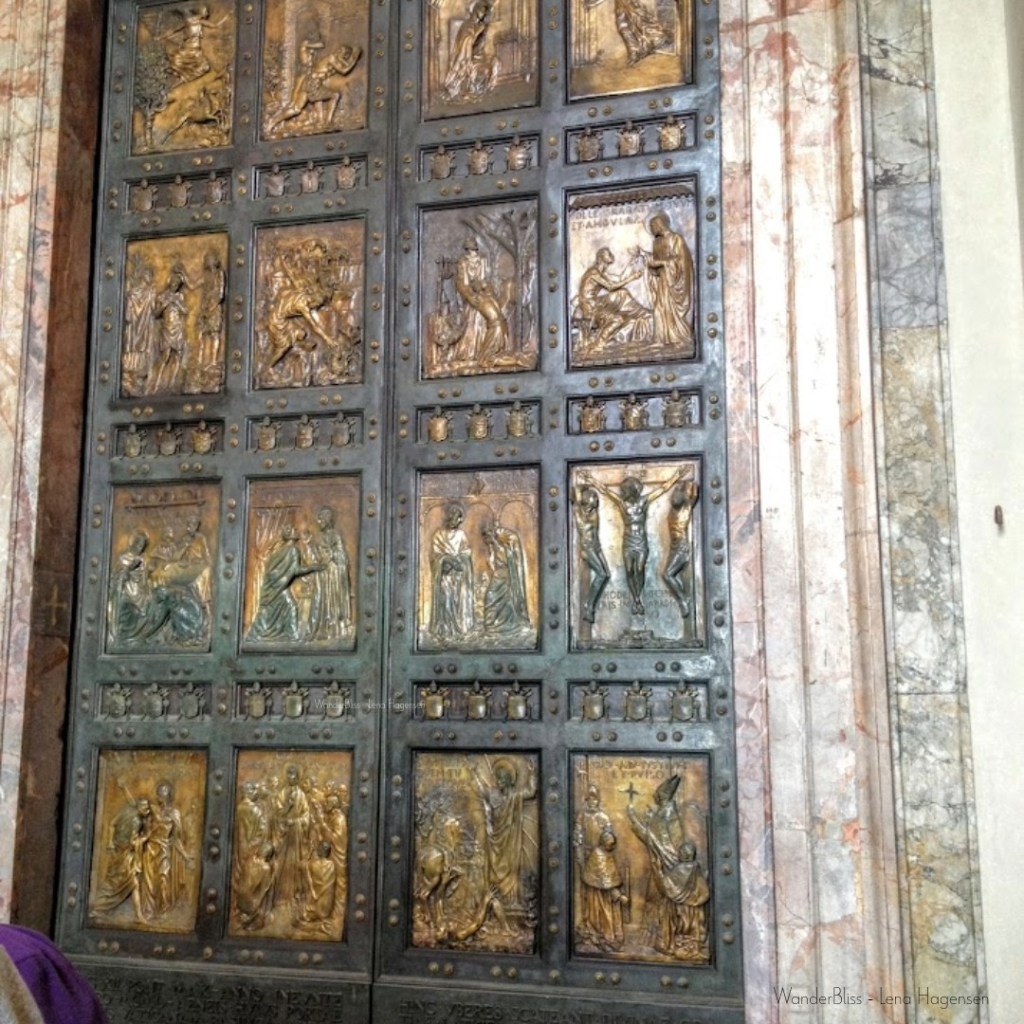
Inside St. Peter’s Basilica, one can find the Holy Door (Porta Santa) — a deeply symbolic element in Catholic tradition.
According to my guide, the door itself may be the only surviving piece from the original basilica.
Whether it truly dates back to the first St. Peter’s Basilica is uncertain, but its significance is beyond question.
The Holy Door plays an essential role during the Catholic Church’s Jubilee celebrations.
Originally, Jubilees were celebrated every 100 years, but as the chances of witnessing one during a lifetime were slim, the interval was later reduced — first to every 50 years, and eventually to every 25 years.
Today, Jubilee Years are held every 25 years, offering the faithful a special opportunity for reconciliation and the remission of sins.
The Holy Door is ceremonially opened at the beginning of each Jubilee Year, symbolizing a passage to grace and renewal.
In 2016, an Extraordinary Jubilee of Mercy was proclaimed (from December 2015 to December 2016).
And now, in 2025, we find ourselves once again in a Holy Year — marked not only by the opening of the Holy Door but also by the passing of Pope Francis, a historic moment for the Catholic world.
But, Was Peter really in Rome?
The question of whether the apostle Peter actually was in Rome has been debated for centuries.
According to Catholic tradition, Peter – one of Jesus’ twelve apostles – was martyred in Rome under Emperor Nero around 64–67 AD.
Peter’s tomb is believed to lie directly beneath the high altar of the Basilica, and it was over this site that Emperor Constantine built the first St. Peter’s Basilica in the 4th century.
Archaeological findings from the 1940s suggest that a revered grave existed here as early as the second century, but scientific proof that it belongs to Peter remains elusive.
Nevertheless, for countless believers, this place remains a powerful symbol of continuity back to Christ himself.
📜 Facts About Peter and Rome
- Does the Bible say Peter was in Rome?
No, the Bible does not directly mention that Peter was in Rome. - What does the Bible say?
Peter primarily worked in Jerusalem and nearby regions. In 1 Peter 5:13, he sends greetings from «Babylon,» which many scholars believe symbolizes Rome. - What does tradition say?
Early Christian sources claim that Peter was martyred in Rome under Emperor Nero around 64–67 AD. Tradition also says he was crucified upside down. - What exists today?
A tomb believed to be Peter’s is located beneath St. Peter’s Basilica in Rome. The Papal Plaque inside the Basilica shows an unbroken line of popes from Peter to the present day.
A Historic Pause: Awaiting a New Pope
Today, that unbroken line faces a historic pause:
Following the death of Pope Francis, who was laid to rest on Saturday, April 26, 2025, the Catholic Church is currently without a leader.
The world now turns its eyes to the upcoming conclave, where the College of Cardinals will gather beneath Michelangelo’s frescoes in the Sistine Chapel to elect the next pope.
It is a time of deep reflection, solemnity, and global anticipation — a moment when history and the present truly walk hand in hand within the walls of the Vatican.
As a visitor, regardless of one’s personal beliefs, it’s hard not to be moved by the grandeur of St. Peter’s Basilica.
It is a place that shows what humanity can create when faith, art, and vision come together – a longing for the eternal, carved in stone and marble.
Note: It is important to remember that all visitors entering St. Peter’s Basilica must have their shoulders covered, as a sign of respect for this sacred place.
I hope you will take the time to visit St. Peter’s Basilica the next time you are in Rome — I certainly will!
Arrivederci!

 ReiseMinner
Legg igjen en kommentar